Print this page using your browser menu option, then click here to return
Birding in April 2010
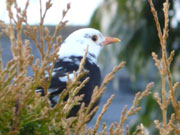
We are awakened regularly just before dawn breaks by a group of Blackbirds who sing a burst of rich, fluting notes, pause, and then repeat the phrase. Many of these singers are young males who are taking up a territory for the first time this year. They need to assert their presence by singing and have a characteristic way of flying up to a branch or a roof, lifting their tail high for a moment, and immediately begin to sing. The boss of this group is a ‘pied variety’ who chases the others around defending his boundaries, they confront each other, either spreading their tail and humping their back, or stretching themselves up very tall.
The Wrens, my wife Julie’s favourite birds, are singing here and there, but they are not so noticeable as they would normally be by now, we think this may be due to the harsh Winter, we fear many of them died during the freezing weather in January. Such tiny birds with a big name (Troglodytes troglodytes) need to feed almost continuously on very cold days, and in January, when insects were harder to get at, some wrens may not have found enough. Those that have survived will start singing vigorously once it turns warmer, they will also start singing higher in the trees, when one can see more clearly how their whole body shakes with the effort. Like the blackbirds they defend their territories fiercely in spring, and one can sometimes see two of them having a battle in the air, fortunately they have large families, so after a good summer their numbers will pick up again.
Blue Tits are investigating our nest boxes and cleaning out the old nesting material, we are not expecting them to make their new nest or start laying eggs just yet as they do not want their chicks to hatch before the oak trees are full of moth caterpillars in May, since those are their principal food.
The other delightful singers the Song Thrushes have starting to sing producing their distinctive loud, ringing notes Some pairs are already building sturdy nests in our hedges, in which the female will lay four or five turquoise eggs with a scattering of black spots on them. A few early blackbirds are also building and their nests can be identified by carefully peering inside them. The song thrush’s nest is lined with bare mud, while the blackbird’s is a much cosier affair, well lined with dry grass.
Swallows are coming back to our local farms where they will nest. They are loyal from year to year to the same old barns and outhouses, where they build their mud nests on the rafters — though these nesting sites are steadily disappearing nowadays. However swallows are resourceful birds, and have been known to nest in the roofs of bus shelters and other unusual sites.
When they first return from South Africa they roam far and wide in search of flying insects, but later this month there will be enough aerial food around for them to turn their attention to breeding. They are swift flyers, and their glossy blue backs glitter as they swoop and swing to pick up prey. They have long tail streamers, and the female swallows are known to prefer the males who have the longest and finest examples of these. The males have a sweet, twittering song that is heard both when they are flying and when they are sitting on a barn roof or a telephone wire.
The first cuckoos have also been heard in the south, but they are coming in to us a little late this year. The first arrivals are the males, who fly around over a large area making their “cuckoo” calls, hoping to attract females to mate with. However, they form no bonds with the females, who go off quite independently to lay their eggs in other birds’ nests.