
Birding in June 2010
Early last week we were privileged by a brief visit from a very scarce passage migrant the Turtle Dove. It was a small dove, slim with a wedged shaped tail and narrow angled wings. It was warm brown with a pink flush to the breast and a striped black and grey neck patch . This delightful summer visitor, a bird of the countryside which likes our local rural agricultural environment, is to be found in open meadows or near gardens. It winters in tropical Africa and sadly is subject to very heavy hunting pressure in the Mediterranean countries as it migrates northwards to its breeding grounds.
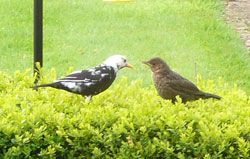
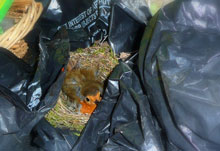
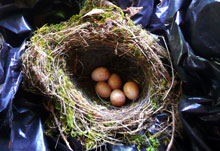
Meanwhile we have been watching a pair of blackbirds building a nest in our climbing hydrangea just outside our bedroom window. The division of labour consists of Mrs B arranging and constructing the nest whilst Mr B collects and delivers copious material; we are hopeful of further developments. Julie spied our resident Mr Pied blackbird feeding his mate so hopefully they too will have a brood of maybe little pieds soon. Other blackbirds have already produced fledgling, we have heard thin notes from the depths of our hedges and shrubs and they are reluctant to come out, but when they do they are like their brown-plumaged mother, but are more speckled and streaky. There are usually about four fledglings, and sometimes the father and the mother each take care of two of them. The cycle from egg laying to the fledgling of the young usually takes just over a month. The nest will not be used again. It is known that the mother is often quite quick to build a new nest and rear a second brood, and later in the summer may even have a third family.
The first Cuckoos are back, the earliest local sighting was on the 21st April at Lower Lea Bailey. You too may hear one of them calling from far away, moving about in distant trees, but if you set off in pursuit you may not always find it
It reminds me of William Wordsworth's poetic sentiments:
"O, Cuckoo! shall I call thee Bird, Or but a wandering Voice?"
If you are very lucky you will see it, it is a dove-sized bird with blue grey upper parts, head and chest with dark barred white under parts, calling "cuck-oo" usual repeating in a G & E flat call in a resolute way from a high branch. With their sleek body, long tail and pointed wings they are not unlike kestrels or sparrow hawks. When it flies off it looks rather shifty, not flapping its wings energetically like other birds, but keeping them always below the horizontal with a half-gliding motion. The females are arriving just now. They are like the males but have a bubbling call. They will meet up and mate, but never pair up and hold a territory together. The fertilised females go off on their own looking for hedge sparrow or reed warbler nests. They lay a single egg in each nest that they find, and leave the care of their gigantic chick to the foster parents.
Singing is in the air. The most noticeable of which are the wrens. Their songs astonishingly vigorous and rapid for such a small bird can be heard ringing out from the undergrowth at all hours of the day. Their whole body vibrates with the effort of it. Another bird that is still singing regularly is the chaffinch, which offers a brisk and cheerful-sounding run of notes with a twirl at the end. Whist walking down our lane amongst the tall hedges, I often hear six or seven of them singing in the hedgerow trees in the course of a mile.
They are also singing everywhere in and around the school, church and village hall and in our gardens. In both these species the female incubates the eggs, which gives the male time to sing and warn off any intruding males who might approach his mate, or try to take over part of his feeding territory. When the eggs hatch, the male will help his mate to feed them, and there will be less time left for singing. These two species are probably the commonest breeding birds in Britain, the Wren leading with more than eight million pairs, and the Chaffinch with almost six million pairs.
D. H.
Local Reported Sightings 2010
| Date | Species | Location | Sighter |
|---|---|---|---|
| March 29 | Swallow | S.H. Golf Club | Sally Studsbery-Turner |
| April 1 | Swallows | Twin Lakes, Bromsash | Fiona Leatheart |
| April 9 | Swallows | Hope Mansell | Caroline Elmitt |
| April 14 | Skylarks/House Martins | Fields between Pontshill &: Weston | Tony Bowell |
| April 15 | Goshawk | Bromsash/Linton | Claire Dale |
| April 17 | Yellow Hammers | Weston Park | Sally Studsbery-Turner |
| April 21 | Cuckoo | Lower Lea Bailey | Ben Hall |
| April 28 | Jay | Rectory Lane | Marsha Barnsley |
| May 5 | Turtle Dove | Bromsash | Julie Herrod |