
Wartime in Hope Mansell
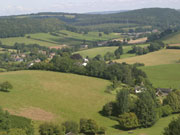
I was born in 1934 so was just five and half when the Second World War started. We lived on a small farm in Hope Mansell, Herefordshire (known then as Hom Rough Farm but has been changed to Hom Grove), about half a mile from our nearest neighbour and one mile off the main road. It was a dairy farm producing milk, poultry, providing eggs, and meat and pigs. The pigs could be slaughtered under licence on the farm for bacon and pork. There was no electricity so the cows were milked by hand and the milk poured into churns and cooled in the nearby stream. My father, Jim Davies had a milk round where the customers provided their own jugs and the milk measured directly into them. He also sold eggs and dressed chickens to them.
As there was no electricity, there was no television and I can’t remember when we had a phone. We had a wireless, which was operated by a battery that had to be taken to the garage to be recharged. I remember my parents sitting round it listening to the declaration of war and of course they were very nervous and apprehensive of what was to come.
The school I went to was in Drybrook and was about 2 and half miles away. My father would take me in the morning and I walked back at night thinking nothing of it. The school had to tape all the windows in a criss-cross fashion with masking tape. This was to prevent the glass shattering in the event of a bomb. We carried gas masks in small brown boxes at all times and had numerous drills to learn to use them correctly and how to evacuate school premises to shelters, which fortunately we never had to use. I had two small brothers; one, (Bryan Davies) who was just a baby had an all-in-one gas mask, which looked very Doctor Who-ish.
Rationing during the war didn’t seem to affect us. We had milk, eggs, grew vegetables and fruit, made our own butter and bread and had poultry meat and pork. The pork was salted and hung on the kitchen walls as deep freezers weren’t around then. When I watch documentaries I do feel quite guilty as we lived quite well. We did have ration books and coupons, but our lives were comfortable compared to some people. I was just a child and parents provided for their children and did their very best for them. We didn’t have many toys; I had knitted teddies and dolls and my brothers had wheelbarrows made by the local carpenter. One of the highlights of the year was when the pigs were killed on the farm the bladders could be inflated to use as a football. As the bladder is a very muscular organ, the football lasted a long time and we had great fun.
We had evacuees boarding with us; four boys from London aged five to eight. They arrived very frightened and nervous as the countryside was like a foreign country to them, with no traffic, buses or trains. They had never seen farm animals before and had never had home-grown produce or milk that did not come from a bottle! It did not take them long to settle down, though of course they missed their family. We had a wood close by and one day just before they returned to London, we all carved our initials in the bark of a big beech tree. They are still there seventy years on!
We didn’t really suffer air raids and bombing like the big cities, but the raid on Coventry stands firmly in my memory. The Germans had concentrated on London, but in October and November, they changed their strategy and attacked the industrial factories in the Midlands and the dock areas of Cardiff, Swansea and Bristol. On the night of the Coventry raid my father had a cow calving in a small cowshed. It was proving a difficult birth and she needed help. As there was no electricity the only light came from a small oil lantern and you had to be very careful not to let any light escape which could be seen from outside. As I have said before we had no telephone so were unable call for a vet, so it was all hands to the pump! The German bombers were going over fairly low and slowly as they were laden with bombs. They always flew in formation and their engines made a very recognisable noise. We didn’t know where they were heading, but towards dawn there was a huge orange glow in the sky. It was the fires burning in Coventry and the city had been virtually flattened, which included considerable damage to the Cathedral. We learned all this when we listened to the wireless. The memory of that night will live with me forever. The nearest bombs fell about five miles away; rumour has it that a man going home drunk from the pub with his dog showed a light and a bomb was dropped. The man lived but his dog died.
Just above the farm, deep under a hill was a railway tunnel where British bombs were stored. This was guarded in turn by the three services, the Army, Navy and Air Force. There were no trains, but the tracks were used to transport the munitions. There was a radio station called ‘Radio Germany’, which was used to broadcast propaganda to frighten British people. A man called Lord Haw-Haw, William Joyce, would talk about bits of the country and what Germany would do to destroy them. The call sign he used was ‘Germany calling, Germany calling’ and sounded very ominous. One day my mother was listening and she heard him describe the tunnel, the bombs stored there and all the little farms nestling in the valley below and how he would blow them all up. Needless to say, she was in a terrible state and very frightened, but being my mother, just got on with life. Up the lane from the farm, a caravan appeared with two people living in it. They came to the farm for their milk and eggs and in hindsight they were probably German spies relaying information back to the Germans. They and the caravan disappeared as quickly as they came. It was a quiet, unused lane so was an ideal spot for them. Today, we might all have suspected terrorism or spying, but not so much then
In the later stages of the war an American airbase was set up about four miles away. They were short of water and would come to the farm with large tanks for the drinking supply. We children thought they were wonderful, mainly because they were so generous with chewing gum and sweets. Then one day they told us they were leaving and we watched them go away in convoy. Afterwards we learned that they had gone to take part in the D Day landings and that a lot of them had lost their lives.
In 1945 I took the scholarship to gain entry to Ross Grammar School. My mother gave me fish for breakfast that morning as in those days people believed that fish was good for the brain! It must have worked as I passed and was given a bicycle as a reward.
We used horses on the farm during the war, but around 1947, my father bought a grey Ferguson tractor. I loved that tractor – much more fun than the monsters of today! I worked very hard as a child on the farm and remember helping on the threshing machine. The Health and Safety Executive would have a field day if children did that sort of thing today. Rationing went on a long time after the war ended, but I remember being very excited when oranges appeared in the shops again!
When I was a district nursing sister twenty-five years later in the same area that I grew up, people could still remember me delivering milk to their doors and still treated me like a child and not as a district nurse! Lots of my patients had served in the First World War and I would spend hours listening to their stories of Passchendaele and The Somme; it must have been hell on earth for them.
When I look back now, my childhood seemed very idyllic and I was very lucky. I had good hardworking parents who cared for us. There were thousands who were a lot worse off and who had suffered tremendously, but we all came through it. Britain was re-built and life moved on…just Local Memories left.
Joy Evans (nee Davies)